

Running a business is a huge task. You control people, products, every day risks. One of the greatest risks is for an employee to get hurt on the job. This is where workers compensation insurance comes in. It is a crucial safety aid for either you or the team of men.
This insurance has certain benefits for your employees. It covers them if they get sick or injured because of their job. Think of it as an important component of your business operations. In most states, it’s not just a good idea. It is the law.
Having this policy is beneficial in protecting your employees. It makes sure that they get medical care. They are also provided with wage replacement. This helps them in recovering without going financial ruin. You can’t hope for the best; you have to plan for the worst.
It also protects you (the employer). Without workers comp insurance, you would be personally liable. The single serious injury could bring a massive lawsuit. This has the potential to bankrupt your company easily. This guide will help discuss all that you need to know. We want to assist you to find the proper insurance coverage. It’s a key step to affordable business insurance for your company.
The “Grand Bargain”: Understanding the Core of Workers Comp
You’ll hear the words “grand bargain” possibly. This is the basis of workers compensation. It is a fundamental trade-off. It was designed more than 100 years ago. This system is beneficial for both parties.
Here is how it works. Employees who are injured at work are compensated. These benefits are paid regardless of the fault. The employee does not need to sue you. They don’t have to prove that you were negligent. They need only to prove that the injury occurred at work.
In return for these no-fault benefits, the employee forgoes something. They usually waive the right to sue their employer. This is an enormous protection for your business. It protects you from costly and unexpected personal injury lawsuits.
This bargain maintains stability of the system. Employees receive rapid medical attention. Predictable costs are provided to employers. You pay your premium. The insurance company takes care of the claims. This is far preferable than going up against a jury.
What Does Workers Compensation Insurance Actually Cover?
So, what are you paying for? There are a few key categories of a worker’s compensation insurance benefits: These are designed to get an employee to recover fully. They want to get them back to their life and job.
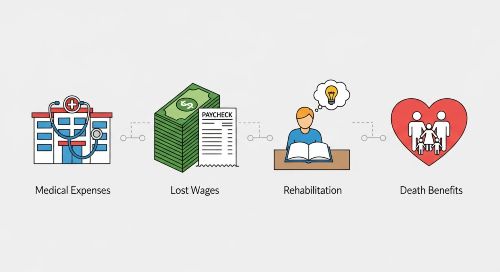
Medical Expenses
This is the most prevalent benefit. It provides for all reasonable and necessary medical care. This begins from the moment of injury. Ambulance rides and emergency room visits can be included.
It also covers follow-up care. This translates into doctor’s appointments and specialist visits. Prescriptions are covered. Surgeries are also paid for. The goal is to heal the injury.
This coverage can endure for a long period. Some injuries will require long-term physical therapy. Others may require complicated rehab. Workers compensation reimburses directly for these costs. Your employee should have no out-of-pocket medical bills.
Lost Wages (Disability Benefits)
What if an employee is unable to work? A job injury can refer to weeks or months off. This is where the lost wage benefits put to use. They substitute a part of the person’s regular income.
These benefits are of different types. Temporary Total Disability (TTD) is widespread. This is paid when the employee is unable to work at all for a short time. Temporary Partial Disability (TPD) are for light duty work. It compensates for the low number of hours or the low pay check.
Some injuries are more serious; Permanent Partial Disability (PPD) is compensating you for a permanent impairment. An employee may lose a finger, for instance. Permanent Total Disability (PTD) is for serious cases. This is when an employee can never get back to work again.
Rehabilitation Services
Sometimes an injury strikes up the wazoo. An employee may not be in a position to return to their job previously. A back injured roofer is a classic example. They cannot safely climb on ladders anymore.
Working people can use workers compensation for help. It may cover the cost of vocational rehabilitation. This service aids in the retraining of the worker. They can learn new skills to enter into a new career. This helps them to become productive again. It is a positive outcome for a tough situation.
Death Benefits
This is the worst case scenario. If an employee dies from a work-related injury, benefits are provided. These are paid to the surviving dependents of the employee. This typically means their spouse and children.
These benefits help the family survive. They provide some of the lost income. They also help pay funeral and burial costs. No amount of money can replace a person. But this benefit avoids a financial tragedy on top of a personal one. This protection is as important as State Farm Life Insurance is for a family’s future.
Who Needs Workers Compensation? The Legal Requirements
This is a simple question with a complex answer. Nearly all businesses that have employees require workers compensation insurance. But more specific rules are decided by the state. There is no one single federal law.
This means your requirements are dependent on where you are operating. You have to comply with the laws of the state in which your employees are working. If you have employees in several states, you must follow the rules in the different states.

State-by-State Variations
State laws are very varied. Some states require coverage if you only have one employee. This includes part-time workers. Other states set the bar even higher. They may say three or five employees.
You’d need to look into your part of the nation’s laws. Do not guess. The penalties for failure to comply are severe. They can include huge fines. In some cases, officials can close your business. You may even be faced with criminal charges.
A few states are “monopolistic.” These include Ohio, North Dakota, Washington, and Wyoming. In these states, you have to purchase the workers comp through a government state-run fund. You can not buy it from private insurances. Most states, however, are in a competitive market.
What About Small Businesses?
Many small business owners make a mistake. They believe they are too small to require coverage. This is a very dangerous presumption. As mentioned, many states say one employee is the trigger.
Do not ignore the law. The cost of a policy is minuscule compared to the cost of a lawsuit. Or the cost of state fines. Protect your business as much as possible by obeying the rules. This is a basic component of your risk management.
Are Owners and Executives Covered?
This also depends on your particular state. And on your structure of business. If you are a sole proprietor and do not have employees, you cannot be required to purchase it. You are not your own employee.
But what about partners? Or officers of a corporation? In many states, they are automatically covered. However, they may often choose to “opt-out.” This means that they forgo coverage for themselves. This can save money in terms of premiums.
Why opt out? You may have some good health insurance. You also may have a private disability policy. But this is a risk. If you become injured on the job, your health plan may refuse to pay the claim. They will tell you it’s a workmans comp. It can get very messy.
KEY WORKERS’ COMP RISKS
What Isn’t Covered by Workmans Comp?
Workmans comp is an all-encompassing term but not every. There are certain exceptions. This is important to know, in order to know these exclusions. It helps you to manage the expectations. It also helps you to identify fraud.
Injuries that occur during the course of a normal commute are typically not covered. Driving to and from work is not “on the job.” An exception may be in the case of an employee driving a company vehicle. Or if they are traveling from work site to work site.
Self-inflicted injuries are not covered in. An employee may not purposely harm themselves. This is fraud. Also excluded are injuries of horseplay or roughhousing. If an employee is violating a specific safety rule, the claim may be denied.
Intoxication is a major exclusion. If the employee is drunk or on illegal drugs, no benefits are awarded. This is why many companies have post accident drug testing. It is a fact of the claims process.
Safety is not some intellectual exercise to keep us in work. It is a moral responsibility to protect our most valuable asset which is our people.
How Are Workers Comp Insurance Premiums Calculated?
This is a million-dollar question for some businesses. Your premium is not some random number. It is based on a particular formula. The first step is an understanding of this formula. It is the key to controlling your costs.
Your premium begins off with two main things. Your industry and your payroll. Insurers use the following data to rely on your base premium. Then, your company’s individual safety record makes adjustments.

Classification Codes (Class Codes)
Every job has a “class code.” This is a four-digit number that is given by a rating bureau. It reflects the risk of that particular job. An office clerk (8810) has an extremely low-risk code. A very high-risk code is for a roofer (5551).
Each class code has a rate. This rate is the cost to insure $100 of payroll for this job. The roofer’s rate might be $25. The clerk’s rate might be $0.25. This indicates the enormous difference in risk. This risk assessment is not the same as professional liability insurance, which does not cover physical risk, but only financial risk.
Payroll (Remuneration)
The second part is the payroll. The insurance will look at the total payroll for each class code. Let’s you got office payroll of $100,000. They divide this by 100. That gives 1,000 units.
They multiply these units by the rate. 1,000 units × $0.25 rate = $250. This is the base premium for your office staff. As another example, let’s consider your roofers. 1,000 units × $25.00 rate = $25,000. Your total base premium is $25,250.
The Experience Modification Rate (EMR or Mod)
This is most important part that now you control. The EMR or Mod is a number available for you for comparison of your claims history. It compares you to the average in your industry. It is a direct number of how safe you are.
The average EMR is 1.0. If your EMR is less than or equal to 1.0 you pay the base premium. If you have fewer claims than average, you will have a lower EMR. An EMR of 0.85 means that you receive a discount of 15%. Your $25,250 premium becomes $21,462.
If you have a higher number of claims than average, your EMR will be higher. An EMR of 1.15 indicates that you pay 15% surcharge. Your $25,250 premium becomes $29,037. This is how a bad safety record just costs you money directly.
How to Get a Workers Compensation Policy
You know you need it. You know how it’s priced. Now, how do you buy it? You have a few options. The right one is dependent upon your state. It is also based on the size and the risk level of your business.
Private Insurance Carriers
This is the most common one and is known as the most common method. You purchase a policy from private insurance company. Think – Big names such as The Hartford or Travelers or Chubb. It is also possible to use smaller, regional carriers.
You can buy a policy directly. Or you may work with an independent insurance agent. An agent can get quotes from several companies. This will assist you in comparing the prices and the coverage. It’s a good idea to shop around, just as you would for United Healthcare insurance plans.
State Insurance Funds
Many states have their own workers comp fund. This is an insurance company that is non-profit and state-run. This is competing with private carriers. Sometimes, it is referred to as the “insurer of last resort.”
State funds will often insure businesses that private carriers refuse. If you are in a very high-risk industry, then you may have to use the state fund. Their rates might or might not be competitive. It varies by state.
Monopolistic State Funds
As we said, four states are monopolistic. Ohio, North Dakota, Washington and Wyoming. If you work there, you have no choice. Your workers comp is something that you have to purchase from the state fund. Private insurance is not an option.
Self-Insurance
This is something only suitable for very large companies. In order to self-insure, you have to obtain the state’s approval. You have to prove that you have got enough cash. You need to be able to afford potentially catastrophic claims. Millions of dollars are put aside by you.
For 99% of businesses, this is not a feasible option. It is far too risky. It is far safer to transfer that risk. You pay a premium amount to any insurance company. They take on the risk for you.
Workers’ Compensation Key Risk Factors
The Claims Process: What Happens When an Employee Gets Hurt?
An injury is a stressful event. Understanding what are the steps to take is critical. You have to do it quickly and correctly. An obvious process provides a level of protection for your employee. It is also the one making sure your workers comp claim is taken care of without any hassles.

Step 1: Immediate Medical Attention
This is always the first priority. There is nothing more important than your employee’s health. In the event of serious injuries call 911 immediately. Do not wait. For non-emergencies, the employee should be directed to an approved medical provider.
You should have a list of the approved clinics. Post this list in a place where employees can see it. Make sure supervisors are aware of the process. Faster medical treatment is the right thing to do. It also helps to prevent an injury from getting worse.
Step 2: Employee Reports the Injury
The employee needs to report the injury to you. This should occur as soon as possible. Most states have a deadline when this has to done. It could be 24 hours or 30 days.
After they have reported it, you will need to provide a claim form. This is an official document of the state. The employee completes his/her section. They describe what happened. They list the body parts injured.
Step 3: Employer Files the Claim
You must then file this claim. You file it with your workers comp insurance carrier. Do not delay. Most states require that you file within the period of a few days. Do not attempt to handle it alone.
Never pay for the medical bills out of pocket. And never pay the employee “under the table.” This is illegal. It can viewed as a way of evading a claim. Report every single injury. Even small ones. A small cut can get infected.
Step 4: The Insurer Investigates
As soon as the insurer has the claim, they take over. A claims adjuster is assigned. They will contact you. They will also contact the employee. He or she will talk to the doctor.
Their task is to establish whether the claim is valid. Was the injury work-related? Is the medical treatment appropriate? If the claim is approved, they handle the case. They pay for the medical bills directly. They also send the lost-wage checks out.
Step 5: Return-to-Work Program
The final step is getting the employee back. This is not only good for them, but even good for you. The insurer will collaborate with the doctor. The doctor will tell the employee when he can return.
They may have restrictions. This is called “light duty.” You need to try to accommodate this. Arrange for a temporary modified job. This gets the employee working again. It helps their recovery. It also dramatically reduces the cost of the claim. This is a key part of total health much like Humana Dental Insurance.
“The measure of a company’s success is how it treats the employees, most especially when they are at their most vulnerable.”
Strategies to Lower Your Workers Compensation Costs
Your workers compensation premium is not constant. And MR: You have a lot of control over it. A safe workplace is a profitable one. Taking some proactive steps you can save thousands. It will help reduce your EMR directly.

Prioritize Workplace Safety
This is the number one strategy. Prevent foul-we get more injuries before they occur than we do during the war. This begins with a formal safety program. Write it down. Make it a part of your company culture.
Hold safety meetings on a regular basis. Provide the appropriate personal protective equipment or PPE. Train every employee regarding safe procedures., These rules need to be strictly enforced by your supervisors. The worst consequence of negativity is that a strong safety culture is your best defense in. It requires as much care as checking if your motorcycle insurance policy is good before you go on a ride.
Implement a Return-to-Work Program
We just discussed this. It is vital for cost control. The claim cost increases rapidly when an employee goes out. Bringing them back on light duty stops the bleeding. It lets your employee know that you support him or her.
This has a huge impact on your EMR. Claims without any lost time are greatly discounted by insurance raters. A “medical only” claim costs you much less. Planning your light-duty jobs in advance before an injury occurs.
Classify Employees Correctly
This is a serious mistake to avoid. Make sure that all employees are in the correct class code. Do not place a roofer in the office clerk code in an effort to save money. This is premium fraud.
An audit will catch this. You will be indebted of all the back-premiums. You will also face huge fines. Be honest. But also be accurate. Review your codes with your agent. You could be paying too much, if someone is in the wrong, more higher-risk code. This is as important as having the right commercial auto insurance option for your vehicles.
Understand Your EMR
Review every year your EMR worksheet. Such is the document that displays how your mod was calculated. Mistakes happen. The insurer may have an old claim that is listed as open. Or the payroll data may be incorrect.
Dispute any errors you find. A little correction will alter your EMR. This can save you real money. Do not just accept the number. Verify it.
Partner with Your Insurer
The enemy of your insurance company is not you. They want you to be safe. Less claims imply higher profits to them. Take advantage of their sources.
Safety materials are also free with most carriers. They possess training videos online. Others will even appoint a loss-control expert to your premises. They can spot risks you miss. Work with them. There are also free guides available on such government sources as the Occupational Safety and Health Administration (OSHA).
Common Mistakes Employers Make with Workers Comp
Handling workmans comp is sometimes difficult. Making an expensive error is not difficult. The most important thing is to avoid these traps. One wrong move is enough to incur fines. It may also give rise to claims being denied or lawsuits.
Misclassifying Employees as Independent Contractors
This is the biggest mistake. Other employers do cost saving. They refer to their employees as 101 contractors. This avoids payroll taxes. It also evades workers comp premiums.
This is illegal. Tests of IRS and state agencies are strict. They determine subject matter of an employee. They are an employee in case you dictate how, when, and where they work. Do not risk this. The penalties are massive. All back premiums, taxes and fines will owed.
Not Reporting Claims Promptly
An employee gets hurt. You think it’s minor. You tell them to “walk it off.” This is a terrible idea. This small break may be a severe fracture. Or it could get infected.
The postponement in reporting will lead to a rejection of the claim by the insurer. This leaves you liable. It also resembles that you are hiding something. This is capable of initiating a state investigation. Report all injuries however, small. It is the only safe move.
Thinking You’re Too Small for Coverage
We covered this before. It is worth repeating. One part time employee is not an excuse. In the majority of states, such an employee requires coverage.
The risk is just too high. What happens when such one employee falls down? Their medical bills might reach up to $100,000. They might end up being permanently disabled. You will be paying that without workers comp insurance. It will ruin your company.
Failing to Foster a Safety Culture
The presence of a safety manual is inadequate. It cannot be useful when it only sits on a shelf. Safety has to become a normal practice. It has to come from the top.
As an owner, you have to be a role model. Check at the floor, find dangerous places. Reward employees who abide by rules. Culture is good at stopping injuries. It should be your most effective long-term cost control strategy. Insuring your business to this extent is just as particular as getting classic car insurance for a special vehicle.
Paying for Injuries “Out of Pocket”
This is tempting. An employee has a small cut. They need a few stitches. You volunteer to pay the clinic bill of the 500. You request them not to make a claim.
Most states have it as an illegal act. It is believed to suppression of claims. It also exposes you. What if the cut gets infected? There is a possibility that the employee requires an operation. They will file a claim anyway. The insurer is now putting on his doubts. They will inquire why you did not want to found out.
Workers Comp vs. Other Business Insurance
It is easy to get confused. There are numerous forms of insurance that business requires. Workers compensation is unique. It just benefits your workers in times of work accidents. We will examine its comparisons with other policies which are common.
General Liability Insurance
This is a very common policy. It covers third-party claims. This means non-employees. This policy is paid in case the customer slips and falls in your store. When you harm the property of a client by your work, it pays.
It is not an employer-based policy. When the employee and a customer both fall and are injured, then you are going to get two claims. Workers comp covers the worker. The customer is paid by the General Liability. You need both.
Professional Liability (E&O)
This is also referred to as Errors and Omissions (E&O). It covers financial losses. It defends your negligence claims. Or bad advice.
This is required by a tax accountant who commits an expensive mistake. It requires an architect whose design is defective. It does not deal with bodily harm. Financial injury is covered by it. This is quite distinct from workmans comp. It is such as the one at term life vs. whole life insurance; they are both insurance, but of completely different purposes.
Disability Insurance
This is the main area of misunderstanding. Disability insurance makes money. It compensates in case a person is not able to work because of disease or injury. However, it normally addresses matters that are not work-related.
Disability insurance pays in case your employee breaks his or her leg skiing during his or her vacation. If they break their leg falling off a ladder at work, workers comp pays. There are states such as New York that mandate you to supply a separate short-term disability policy.
The Future of Workers Compensation
The business environment is evolving rapidly. It is changing workers compensation. These trends must known to you as an employer. They will impact on your business. They will also have an impact on your premiums.
The Rise of Telecommuting
Millions of individuals now commute at the workplace. This creates a new challenge. Coverage of home office injuries? What is a “work-related” injury?
When a worker slips on his/her dog when getting a cup of coffee, is it a work claim? Anything bad about carpal tunnel with a bad home desk set-up? These are convoluted legal issues. It is still a puzzle to insurers and courts. The rules for remote work are different from those for temporary car insurance, which has specific limits.
Mental Health Claims
Traditionally, physical injuries were the only ones to be covered by workers comp. This is changing. Most states have become aware of the so-called mental-mental claims. It is work-related mental pressure.
It may be a first responder who experiences PTSD. A worker who has been subjected to extreme bullying at work might also covered. Such assertions cannot be proven very easily. Nonetheless, they are getting increasingly popular. This is an idiom to kept by all employers.
Technology and Wearables
There is also a change brought about by technology to the game. Motion sensors can monitor the movements of an employee. They are able to buzz when somebody lifts improperly. This will avoid back injuries.
Claim reporting is made instant with the help of apps. This speeds up the process. Telemedicine enables physicians to attend to injured employees through video. This is faster and cheaper. The trends may facilitate the reduction of expenses. For more on industry changes, you can visit a source like Insurance Journal.
“The employer usually gets the employees he deserves. Good, bad, or indifferent.”

Conclusion: Protecting Your People and Your Business
Workers compensation insurance is not just a legal requirement. This is an essential aspect of becoming a responsible employer. It is a promise to your team. It goes, “You get hurt when working under me, I will take good care of you.”
Your business is insured by this promise as well. It shields against disastrous lawsuits. Your costs are predictable. It will enable you to concentrate on growth.
It is not to thought of as a mere cost. Think of it as an investment. An investment in your people. It is an investment in the future of your company. Safety is a way to maintain control over cost. You may convert this legal inhibition into a competitive advantage. This is just the same way you can do things of lowering your car insurance cost.
Frequently Asked Questions About Workers Comp
You will go under intense punishment. It involves huge fines, closure of a business and even possibly jail. It will be your personal responsibility as well to take care of any medical bills and lost wages of an injured employee.
No, it generally does not. But this time you have to be very attentive. Once you got an employee and you wrongly categorize him or her as a contractor, you are going to held liable. The government will just decide to declare them as an employee all along.
This is evolving. Yes, in certain states, in case of extraordinary stress that is obviously work-related. It is very difficult to prove. It does not take ordinary, daily work stress.
Usually, no. This is the “grand bargain.” When the worker agrees to workers comp benefits, he or she forfeits their sovereignty, that is, the ability to prosecute you if or when that injury occurs. Exceptional cases exist, such as in case you had the intention to hurt them.
Immediately. As it occurs, the employee is supposed to report it to you. Then you are to inform your insurance company immediately, as it is typically within 24-48 hours. Delays might put the claim at risk.

![Compliant Drivers Program: Is It Legit for Driver Safety? [2025]](https://propinfo.site/wp-content/uploads/2025/12/Compliant-Drivers-Program-150x150.jpg)







Leave a Reply